

Probate is one of those legal processes that people often find daunting. In short, probate is the court-supervised process of taking assets owned solely by the decedent and transferring them to their heirs or beneficiaries. Most families have experienced the probate process or have heard a horror story or two about what it is like.
Having practiced probate and worked with families in Montgomery County, Tennessee, I have seen firsthand how the process unfolds, where people get stuck, and what practical steps make the experience smoother. I often tell clients that probate can be a long, drawn-out process, but it can also be an efficient process.
In this blog, I will walk through how probate works in Montgomery County, when Tennessee Law requires probate, what the probate process actually looks like here, where estates most commonly get delayed, and what all of this means for estate planning.
When Probate Is Required Under Tennessee Law
Tennessee law requires probate whenever there is property that needs court involvement to pass on to heirs or beneficiaries. That sounds simple, but in Tennessee, the real stress usually comes from misunderstanding how assets are titled.
How Estate Assets Are Titled
To know whether probate is required, you must first know how assets are owned. Most assets fall into one of three categories.
Jointly Owned Assets
Assets jointly owned by the decedent and surviving person often avoid probate. For example, a bank account owned jointly with a surviving spouse or child will pass directly to that joint owner without the need for probate.
Real estate is more complicated. Whether probate is required depends entirely on the language contained in the deed, not simply on whether the owners were married or related.
- Tenants by the Entirety: If spouses purchase real estate during marriage and the deed reflects tenancy by the entirety, the surviving spouse becomes the sole owner automatically, without probate. However, this is deed specific. Marriage alone does not guarantee this form of ownership.
- Joint Tenants with Right of Survivorship: If the deed expressly states joint tenants with right of survivorship, the property passes automatically to the surviving owners without probate.
- Tenants in Common: This is the most commonly misunderstood form of ownership. Many deeds do not explicitly contain the language tenants in common, but the absence of survivorship language often implies it. If property is owned as tenants in common, the decedent’s interest is only transferred through probate.
Because the wording of the deed controls ownership, it is critical to consult with an attorney before assuming real estate will avoid probate in Montgomery County.
Beneficiary-Designated Assets
Some assets are not jointly owned but have a payable-on-death (POD) or transfer-on-death (TOD) beneficiary. This is common for bank accounts, retirement accounts, life insurance, and investment accounts. These assets pass directly to the named beneficiary and do not go through probate.
As of now, Tennessee does not allow real estate to have a beneficiary designation, which is a frequent source of confusion.
Solely Owned Assets
In short, probate is required when an asset is owned solely in the decedent’s name and does not have a designated beneficiary. If the asset was solely in the decedent’s name, it must go though probate to be transferred.
A common question I get when discussing whether probate would be needed is “If I have a Will, does that mean probate won’t be required?” This is a common misunderstanding. Whether or not there is a Will is not determinative of whether probate will be needed. If a person passed without a Will OR if a person passed with a Will and they owned assets titled solely in their name, some form of probate will be required to transfer those assets.
What Probate Actually Looks Like in Montgomery County
In Montgomery County, probate is a court-supervised process, but it is not one-size-fits-all. I often explain probate as existing on different levels, depending on the type and value of the assets involved.
Small Estate Probate in Montgomery County
The key number in Tennessee is $50,000. Under the Tennessee Small Estate Probate Act, estates with $50,000 or less in non-real-estate assets may qualify for an expedited process, whether or not there is a Will.
In Montgomery County, the process typically looks like this:
- The Original Will (if one exists) is filed with the court.
- A Petition for Limited Letters is filed to appoint an executor or administrator.
- Once appointed, the personal representative has one year to complete the administration, which may include collecting assets, selling vehicles, and distributing property.
One of the biggest benefits of a small estate probate is that there is no formal closing requirement. If everything is handled within the year, no further court action is needed.
Muniment of Title in Montgomery County
Muniment of Title (pronounced “MYOO-nuh-muhnt”) is another expedited option, used when the decedent had a Will and real estate is one of the primary assets.
In Montgomery County, Muniment of Title can be combined with a Small Estate probate if the remaining assets qualify. This is county-specific; not all Tennessee counties allow this.
The general process is:
- Confirm a valid Will exists.
- File a petition to probate the Will for the limited purpose of transferring real estate.
- In Montgomery County, the court often signs the order without a hearing.
- The order is recorded with the Register of Deeds.
By recording the court order, this shows the chain of title flowing from the decedent to the beneficiary named in the Will. Once the order is recorded, it is clear to the world (and more importantly, the title companies) that the real estate is owned by the beneficiary. This allows the beneficiary to sell the house, should they choose to do so.
Full Estate Probate in Clarksville
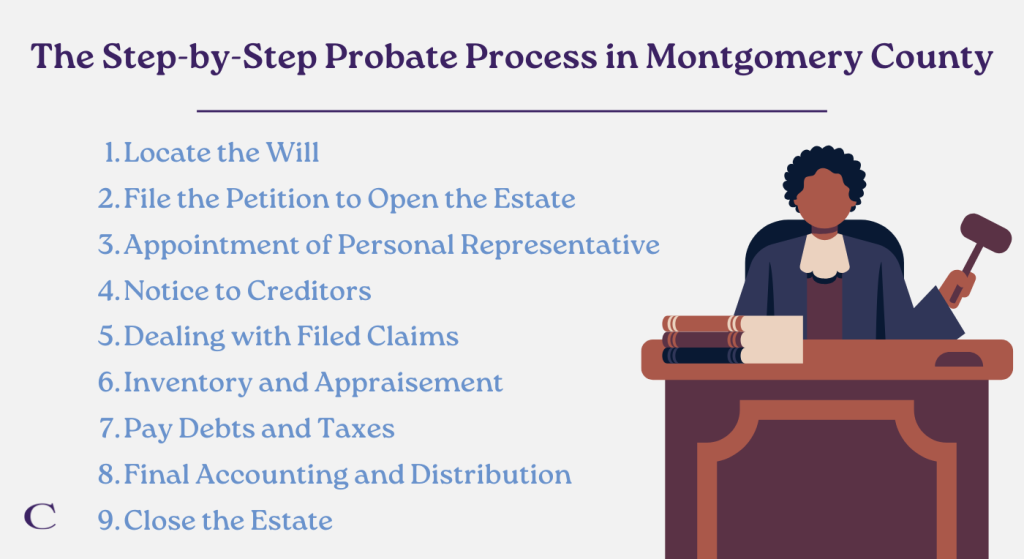
As previously mentioned, $50,000.00 is the make-or-break number. If any non-real estate assets are valued over $50,000.00, a full, formal probate estate must be opened. The following steps break down what this process looks like:
Step 1: Locate the Will
The first question I ask is simple: Is there a Will, and if so, where is the original?
Copies can create complications, and the sooner the original is located, the smoother the process will be. If there is no Will, we proceed on to the next step.
Step 2: File the Petition
The petition formally opens the estate in the Montgomery County Chancery Court and requests appointment of a personal representative. Incomplete filings are the most common reason cases get delayed.
Step 3: Appointment of Personal Representative
If the Will names an executor, the court generally appoints that person unless they decline or are disqualified. Without a will, an administrator is appointed under Tennessee priority statutes.
Step 4: Notice to Creditors
If the decedent passed away within the last year, notice to creditors is required. This creates a four-month creditor period, which is often the longest part of probate.
In July of 2025, the legislature amended the notice to creditor statute. Now, notice must be given as follows:
- Published in a qualifying local newspaper (typically either The Ledger or Mainstreet Media- Clarksville), and
- Published online in a separate qualifying outlet.
Any known creditors must also receive direct notice that an estate has been opened, and they are able to file a claim against the estate.
If over a year has elapsed since the decedent passed away, this step may be skipped. After one year from date of death, any potential creditors are time-barred from filing a claim against the estate.
Step 5: Dealing with Filed Claims
If a claim gets filed against the estate, our protocol is to typically file an exception to the claim. This requires the creditor to attend a hearing to prove their claim with the Montgomery County Chancery Court Clerk & Master. Oftentimes, the creditor does not show up to the court hearing resulting in the claim being dismissed. If the creditor does show up and is able to prove their claim, it typically results in a negotiation to determine what value the estate will pay to the creditor to satisfy the claim.
It is important to note that if the decedent passed away with debt solely in their name, this debt does not transfer to the heirs or beneficiaries of the estate. The only way the creditor is legally required to be repaid is if they file a verified claim against the estate and the court upholds the claim. In such cases, the estate pays the claim before the final distribution of the estate.
Step 6: Inventory and Appraisement
Unless waived, an inventory must be filed listing and valuing estate assets. I advise clients to begin gathering asset information immediately after appointment.
Step 7: Pay Debts and Taxes
Once creditors have had notice, the personal representative pays valid debts and finalizes any remaining tax issues (if applicable). It is often helpful to return to the previous accounting professional that the decedent used as they would be the most familiar to file a final tax return.
Step 8: Final Accounting and Distribution
After debts are paid, the personal representative files a final accounting with the Montgomery County Chancery Court and seeks approval to distribute remaining assets to beneficiaries. This can be waived if all the heirs or beneficiaries sign statements declaring they have received all they are entitled to receive and agree for the estate to be closed without the need for a final accounting.
Even if it is expected that all heirs or beneficiaries will sign off on these statements, it is best to maintain clear records to prevent any confusion or issues in closing the estate.
Step 9: Closing the Estate
Once the accounting is approved or waived, the Montgomery County Chancellor issues an order closing the estate. The personal representative is discharged from any remaining duties.
Where Estates Commonly Get Delayed Locally
When I first started handling probate in Montgomery County, I quickly realized it is far more than paperwork. It is procedural, emotional, and deadline driven. Probate here requires strict compliance with local rules, and missing a step often means returning to court. Based on my experience in Montgomery County, delays most often occur in the following areas:
- Missing or Improperly Filed Wills: Original wills are required. Probating a copy increases the risk of a will contest and can significantly delay administration.
- Creditor Notice Issues: Clerks are required to accept claims up to one year after death, even if the creditor period has technically expired. Estates cannot close while claims remain pending. This can be addressed quickly but can cause estates to remain open for longer than expected.
- Real Estate Complications: Real estate ownership is nuanced. Property that vests immediately in heirs can later require partition litigation if co-owners disagree. In some cases, bringing property into the estate for administration is the cleaner solution. However, this requires court approval for the entire process, including approval of the sale contract.
Planning Implications Based on Local Procedure
After guiding Montgomery County families through probate, a few estate planning lessons are clear.
- Plan for Probate Triggers: Regularly review how assets are titled, especially real estate and financial accounts.
- Use Non-Probate Tools Thoughtfully: Beneficiary designations can dramatically reduce probate involvement when properly implemented. A full probate in Montgomery County Tennessee can last anywhere from six months to over a year. Checking in on beneficiary statuses on key assets can help minimize the type of probate that may be required.
- Consider Alternative Estate Planning Tools: Estate Planning documents, such as Trusts, can help avoid probate if they are properly established and properly funded. Creating these documents in lieu of a traditional Will can help save time and money for your beneficiaries.
- Document Clearly: Vague or inconsistent documents cause delays and disputes in Montgomery County probate court. It is important to have clear and concise language in your estate planning documents to prevent confusion for the courts and your beneficiaries.
- Choose the Right Personal Representative: Probate is procedural and can be a lot for your personal representative. This is a role that people often have to go through while grieving the loss of a loved one. Designating someone who is organized and available can make a difference.
Probate in Montgomery County, Tennessee is structured, rule-driven, and heavily influenced by local court practices. Whether an estate requires a small estate probate, a muniment of title, or full administration through the Montgomery County Chancery Court, understanding the local process makes a measurable difference in outcomes.
If you are facing a probate in Montgomery County, contact Crow Estate Planning & Probate today. Our team frequently represents Clarksville families who have a lost one and need assistance navigating the probate process. Schedule your free consultation today.
About the Author
Deborah Moore is an attorney at Crow Estate Planning and Probate, PLC. After serving as the firm’s summer clerk during her collegiate career, she joined our team of attorneys to assist our Clarksville and Springfield clients in the areas of estate planning, probate, conservatorships, and guardianships. She graduated from the University of Tennessee with her Bachelor of Science degree in Political Science and Pre-Law Studies, then later, her Juris Doctorate from the Winston College of Law at the University of Tennessee. Originally from Stewart County, Deborah is happy to be back in Middle Tennessee to support clients through all stages of life. Learn More.
Licensed in Tennessee