


In my practice serving families throughout Montgomery County, one of the most difficult conversations I have with clients is the moment they realize a loved one can no longer safely manage their own affairs. Conservatorships are rarely planned. They arise when informal assistance is no longer sufficient and legal authority becomes necessary.
Under Tennessee law, specifically Tenn. Code Ann. § 34-1-101 et seq., a conservatorship may be established when an adult is determined to be a “person with a disability.” This means the individual lacks sufficient capacity to make responsible decisions concerning personal care, financial management, or both. The incapacity may result from dementia, traumatic brain injury, mental illness, developmental disability, substance-related impairment, or severe physical decline. When the statutory threshold is met, the Chancery Court for Montgomery County may appoint a conservator to act on behalf of the adult individual, who is legally referred to as the ward.
When A Conservatorship Is Needed in Montgomery County
In Montgomery County, conservatorship petitions are filed in the Montgomery County Chancery Court, and the court often appoints a guardian ad litem to investigate and report back before any rights are removed. The judge must find by clear and convincing evidence that the respondent is a person with a disability and that the proposed conservatorship is necessary.
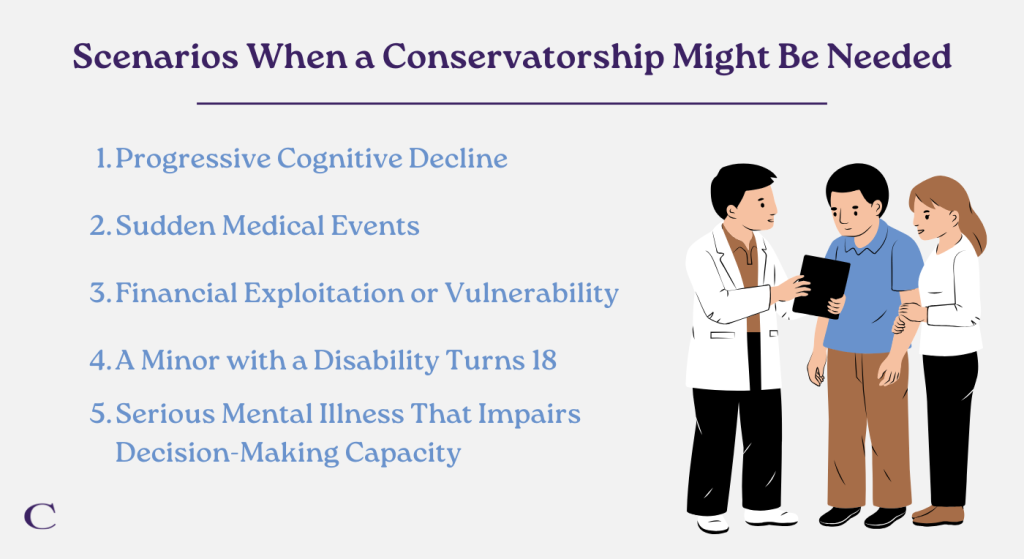
In my experience, these cases typically arise in five recurring scenarios.
- Progressive cognitive decline. Families begin noticing unpaid bills, vulnerability to scams, unsafe driving, confusion with medications, or inconsistent financial decisions. These situations develop gradually, and by the time a family seeks legal counsel, there is often a documented pattern of decline.
- Sudden medical events. A stroke, traumatic injury, or unexpected hospitalization can immediately render someone unable to execute documents or access financial accounts. Financial institutions and healthcare providers generally require formal court authority before recognizing family members, forcing the issue into court.
- Financial exploitation or vulnerability. I frequently see otherwise independent adults targeted by manipulation or predatory conduct. Tennessee law requires courts to consider the least restrictive alternative to conservatorship, but when exploitation risk is significant and no valid power of attorney exists, court intervention may be unavoidable.
- When a minor with a disability turns eighteen. Many parents are surprised to learn that once a child reaches age eighteen, they no longer retain automatic legal authority — even where significant intellectual or developmental disabilities are present. On the child’s eighteenth birthday, Tennessee law recognizes that individual as a legal adult. Without proper planning in advance, parents must petition the court to maintain decision-making authority.
- Serious mental illness that impairs decision-making capacity. Certain psychiatric conditions can, at times, prevent an adult from managing finances, maintaining stable housing, consenting to medical treatment, or protecting themselves from harm. These cases are particularly sensitive. The court does not remove rights simply because a diagnosis exists. The legal question is whether the illness substantially impairs the individual’s functional capacity to make responsible decisions. When episodes are cyclical or fluctuating, the court may tailor the conservatorship narrowly to address specific decision-making areas rather than imposing a broad transfer of authority.
What families often do not initially appreciate is that a conservatorship removes fundamental civil rights. The court is transferring decision-making authority from one adult to another. Because of that, Montgomery County judges treat these petitions seriously and require clear statutory compliance before granting authority.
By the time a conservatorship petition is filed in Montgomery County, informal efforts, such as executing powers of attorney, have usually failed. That reality shapes how the court approaches these cases. Conservatorship is intended to be a protective measure of last resort, not a matter of convenience.
Conservatorship Authority Under Tennessee Law
Once a conservatorship is established, the conservator’s authority comes entirely from the court order and Tennessee statutes, not from family status or personal agreement.
This distinction matters greatly in Montgomery County. I frequently explain that being a spouse or child does not automatically grant authority to manage another adult’s finances or health care decisions. Authority begins only when the court issues Letters of Conservatorship following appointment.
Tennessee law does provide an order of priority. If the ward has designated someone in writing to serve as conservator, that person has statutory priority for appointment. If no written designation exists, the court considers the spouse, then adult children, then other next of kin. Even then, priority does not guarantee appointment. The court must determine that the proposed conservator is suitable and that the appointment serves the best interest of the ward.
Tennessee law permits conservatorships to be tailored to the specific needs of the individual. The court may grant:
- Conservator of the person, with authority over medical decisions, living arrangements, and personal care.
- Conservator of the property, sometimes referred to as conservator of the estate, with authority over financial matters and property management.
- Limited conservatorship, where authority is restricted to specific decision making areas.
- Full conservatorship, where broader authority is granted due to substantial incapacity, typically encompassing both personal and financial decision making.
- Emergency conservatorship, a temporary appointment entered when immediate action is required to prevent substantial harm to the individual themselves, other parties, or property
In all counties in Tennessee, including Montgomery, judges consistently emphasize limitation rather than expansion of authority. The order will specify precisely which powers are transferred to the conservator and which rights remain with the ward. Failing to specifically list the individual powers the conservator has to act on behalf of the ward can be extremely problematic and substantially curtail the power of the conservator to act.
Legally, a conservator serves as a fiduciary. This means the conservator must act solely in the ward’s best interests and remains subject to continuing court supervision. I often remind newly appointed conservators that they do not own the assets they manage. Every dollar belongs to the ward, and every decision must withstand vigorous court review.
Tennessee statutes also require structured financial oversight. In most cases, the conservator must file a detailed inventory of assets and submit a property management plan outlining anticipated expenses, income, and proposed management of the ward’s estate for court approval.
In the Montgomery County cases I handle, this fiduciary responsibility is often where conservators begin to feel the weight of the role. Individuals agree to serve out of love or necessity, only to discover they have assumed a legally regulated financial and personal decision-making responsibility under ongoing court supervision.
The law intentionally imposes these safeguards. Conservatorships exist because someone is vulnerable, and Tennessee statutes are structured to prevent abuse, neglect, and mismanagement. It is unfortunately not uncommon to see formerly trusted conservators misuse and mishandle a ward’s assets.
Montgomery County Court Process and Oversight in Conservatorships
The conservatorship process in Montgomery County begins with the filing of a petition in the Chancery Court for the county where the proposed ward resides. Although the statutory framework is uniform across Tennessee, the manner in which procedural requirements are enforced may differ depending on the Chancellor and the posture of the case. For that reason, careful preparation and familiarity with local practice are critical.
The petition must include medical evidence, which is almost always a sworn examination from a licensed physician, psychiatrist, or psychologist describing the individual’s condition and functional limitations. Without this professional evaluation, the court will not move forward. The petition must also include confirmation that the proposed conservator is not listed on any applicable elder abuse registry.
After filing, the court may appoint a guardian ad litem (GAL). In Montgomery County, this appointment is typically a local attorney who serves as an independent investigator looking out for the best interests of the proposed ward. The GAL interviews the respondent, speaks with family members, reviews medical records, and submits a written report directly to the court addressing whether a conservatorship is necessary and who should serve.
Tennessee law allows the court to waive the appointment of a guardian ad litem in certain limited situations. However, in Montgomery County, the Chancery Court typically requires that any request for such a waiver be presented and decided at a separate hearing before the court will move forward with the final appointment hearing.
In contested cases, the court may appoint an attorney ad litem to advocate for the respondent’s expressed interests. This reinforces a principle I consistently explain to clients: conservatorship proceedings are protective proceedings. They are not administrative formalities. If the respondent wishes to contest a conservatorship, then they are allowed to have counsel appointed to protect their constitutional rights.
The conservatorship appointment hearing is often less adversarial than families expect, but it is highly procedural. The petitioner must establish:
- The existence of a disability.
- The need for assistance.
- The suitability of the proposed conservator.
The Court frequently asks detailed questions about family relationships, financial experience, caregiving capacity, and practical logistics, so preparation is critical. The court seeks assurance that the proposed conservator understands the legal and fiduciary responsibilities involved.
If the petition is granted, the court enters a written order defining the scope of authority and any limitations. Letters of Conservatorship are then issued. Only after those letters are entered may the conservator act on behalf of the ward.
Oversight does not end with appointment. In Montgomery County, the entry of the order marks the beginning of continuing supervision. The clerk’s office reviews required filings, annual accountings, and status reports on an ongoing basis. The court retains authority to require additional reporting, to modify the conservatorship, or to remove a conservator who fails to perform required duties.
I often explain to clients that a conservatorship is not a single court appearance. It is an ongoing legal relationship with the Montgomery County Chancery Court, and the court remains actively involved for the duration of the case.
Ongoing Reporting, Costs, and Restrictions in Conservatorships
For many Montgomery County families, the most surprising aspect of conservatorship is not the appointment itself, but the ongoing obligations that follow. Once appointed, a conservator assumes continuing reporting responsibilities that remain in place for the duration of the case.
In limited circumstances, certain reporting requirements may be reduced or waived. However, when the ward owns substantial assets, the court typically requires full compliance with all statutory reporting obligations.
Within sixty days of appointment, the conservator must file a detailed inventory listing all assets owned by the ward. This includes bank accounts, real property, vehicles, investment accounts, retirement funds, and all sources of income. In many cases, the conservator must also submit a property management plan outlining anticipated income and expenses and explaining how the ward’s funds will be managed to provide for care and support. This property management plan functions as a budget for the ward.
If the conservator is granted authority over financial assets, the Montgomery County Chancery Court frequently requires the posting of a bond. A bond operates as a form of insurance that protects the ward’s estate. If funds are mismanaged or improperly used, the bonding company may be required to reimburse the estate. The bond amount is generally calculated based on the value of the ward’s personal property and anticipated annual income, excluding real estate. Unless specifically waived by the court, the bond must remain in place throughout the conservatorship, and the conservator must pay an annual premium to maintain it.
Reporting continues on a structured schedule. Within six months of appointment, the conservator must file an interim accounting and interim status report. After those initial filings, accountings and status reports are typically required on an annual basis. Each inventory and accounting filing in Montgomery County currently carries a $75 court cost. The initial filing fee for a conservatorship petition is $379.50.
Attorney fees represent a significant portion of overall expense. Many attorneys bill conservatorships on an hourly basis, while others offer flat fees for uncontested matters, subject to court approval. In Montgomery County, attorney fees for an uncontested conservatorship typically begin in the range of $2,000 to $3,000. Emergency conservatorships and more complex cases often begin at $4,000 and increase depending on the circumstances. These amounts vary depending on the attorney and the facts of the case.
- Complexity of the ward’s financial situation. Cases involving multiple bank accounts, retirement accounts, real estate, or business interests require substantially more preparation than cases involving only a single account.
- Whether the ward objects to the conservatorship. If the ward contests the petition or disputes capacity, additional hearings, preparation, and court involvement increase the overall cost.
- Difficulty obtaining a compliant medical examination. Some medical providers are hesitant to complete formal examination affidavits required by the court, which can delay the process and require additional coordination by counsel.
- Organization and responsiveness of the petitioner. When financial records and relevant documents are organized and readily available, the matter can be prepared more efficiently. When documentation is incomplete or disorganized, additional attorney time is required to gather and verify the necessary information.
Guardian ad litem fees and, where appointed, attorney ad litem fees are typically assessed to the ward and paid from the ward’s assets. However, if the ward has limited or no funds, the petitioner may ultimately be responsible for those costs. This is particularly common in cases involving younger adults with disabilities or serious mental illness who do not own substantial assets.
Additional expenses may include bond premiums and professional accounting assistance if the conservator requires help preparing detailed annual accountings.
From practical experience, the administrative burden surprises most first time conservators. Individuals who expected to simply assist with paying bills quickly discover that they are operating in a fiduciary capacity that requires disciplined record keeping and careful financial management. Every expenditure must be documented and defensible. Many conservators initially attempt to prepare required accountings independently but later seek assistance from an attorney or certified public accountant when financial activity becomes complex.
Failure to comply with reporting requirements can result in court sanctions or removal of the conservator. The court retains authority to replace a conservator who neglects duties or mishandles funds.
The principle I emphasize to clients is straightforward. Conservatorship authority carries continuous accountability. It is not simply authority to act. It is a structured legal responsibility under ongoing court supervision.
Frequently Asked Questions About Conservatorships in Montgomery County
How long does a conservatorship take in Montgomery County?
In uncontested cases, a conservatorship typically takes between four and eight weeks from filing to appointment. The timeline depends on how quickly medical evidence can be obtained, whether a guardian ad litem is required, and the court’s hearing calendar. Emergency conservatorships can be heard much more quickly when immediate risk exists.
How long does a conservatorship last?
A conservatorship remains in effect until the court modifies or terminates it. Some conservatorships continue for the lifetime of the ward. Others may be limited in duration if the disability improves or was temporary.
Does the ward lose all rights?
Not necessarily. Tennessee courts are statutorily required to use the least restrictive alternative. Many conservatorships are limited to specific areas, such as financial management only. The court order will specify exactly which rights are transferred and which rights remain with the ward.
Can the ward object to the conservatorship?
Yes. The proposed ward has the right to contest the petition. In contested cases, the court may appoint an attorney ad litem to represent the ward’s expressed interests. The petitioner must still prove disability and necessity by clear and convincing evidence.
Who pays for the conservatorship?
Court costs, guardian ad litem fees, and attorney fees are typically paid from the ward’s estate, subject to court approval. However, if the ward has limited or no assets, the petitioner may ultimately be responsible for certain expenses.
Is a power of attorney better than a conservatorship?
When valid and properly executed before incapacity, a durable power of attorney is often simpler and less expensive than a conservatorship. However, if no valid power of attorney exists or if there are concerns about misuse or capacity at the time of signing, court involvement may be necessary. Additionally, the ward may attempt to revoke the power of attorney, casting doubt on its validity.
What is the difference between a conservator and a guardian?
In Tennessee, a conservator is appointed for an adult with a disability. A guardian is appointed for a minor child who may receive an inheritance or other assets. The procedures are very similar but governed by different statutory provisions.
Can a conservator be removed?
Yes. The court retains ongoing supervision. If a conservator fails to file required reports, mismanages funds, or acts against the ward’s best interests, the Chancery Court may remove and replace the conservator.
Do all conservatorships require a guardian ad litem?
In most Montgomery County cases, yes. Tennessee law permits waiver in limited circumstances, but the court carefully evaluates whether a waiver is appropriate. Typically, when parents are filing a conservatorship for a young adult who may have recently turned 18, the court will most likely waive the guardian ad litem requirement.
How much does a conservatorship cost in Montgomery County?
Court costs begin at $379.50 for filing. Each inventory and accounting filing carries an additional $75 fee. Attorney fees for uncontested conservatorships typically begin between $2,000 and $3,000, with higher costs for emergency or contested matters. Additional costs may include guardian ad litem fees and bond premiums.
Experienced Conservatorship Attorneys in Montgomery County
Conservatorships are among the most serious proceedings handled in the Montgomery County Chancery Court. They involve the removal of fundamental rights, continuing court supervision, strict reporting requirements, and meaningful fiduciary responsibility. Families rarely arrive at this decision lightly. By the time a petition is filed, the situation typically involves real vulnerability, real risk, and real urgency.
These cases require more than paperwork. They require careful preparation, precise statutory compliance, credible medical evidence, and a clear presentation to the court. They also require practical judgment. Every conservatorship must be tailored to the specific needs of the individual while protecting dignity and preserving as much independence as possible.
Our office regularly represents petitioners and families in Montgomery County conservatorship proceedings. We are familiar with the expectations of the Chancery Court, the procedural structure required for appointment, and the ongoing oversight that follows. Whether the matter is uncontested, involves emergency intervention, or presents complex family dynamics, preparation and experience materially affect the outcome.
If you believe a loved one may no longer be able to safely manage finances or personal decisions, early legal guidance can prevent financial exploitation, unnecessary conflict, and procedural delays. Likewise, if you have been asked to serve as a conservator and want to understand your responsibilities before accepting that role, it is important to receive clear advice at the outset.
Conservatorship is not simply a form filing exercise. It is a protective legal proceeding that carries long term consequences. Thoughtful planning and experienced representation make a meaningful difference in how smoothly the process unfolds and how effectively the ward is protected.
To discuss your specific circumstances in Montgomery County, schedule a consultation with our office. We will evaluate whether conservatorship is appropriate, explain available alternatives, and guide you through each step of the process with clarity and preparation.
About the Author
Deborah Moore is an attorney at Crow Estate Planning and Probate, PLC. After serving as the firm’s summer clerk during her collegiate career, she joined our team of attorneys to assist our Clarksville and Springfield clients in the areas of estate planning, probate, conservatorships, and guardianships. She graduated from the University of Tennessee with her Bachelor of Science degree in Political Science and Pre-Law Studies, then later, her Juris Doctorate from the Winston College of Law at the University of Tennessee. Originally from Stewart County, Deborah is happy to be back in Middle Tennessee to support clients through all stages of life. Learn More.
Licensed in Tennessee