
 Noah Darden
When people hear the word probate, they usually picture something complicated, slow, and expensive. By the time a client walks into my office in Springfield, Tennessee, they are often bracing for a year-long legal battle or stacks of paperwork they can’t possibly understand.
As a probate attorney in Springfield, I work with families across Robertson County every week who are surprised to learn that probate is usually far more practical and manageable than they expect — if it’s handled correctly from the start.
In my practice here in Robertson County, I’ve come to see probate less as a dramatic courtroom process and more as a structured administrative one overseen by the Robertson County Chancery Court.
Most estates I handle never involve a fight or contested hearing. Instead, probate typically looks like a series of orderly steps: filing the petition, opening the estate, appointing a personal representative, gathering assets, notifying creditors, paying debts, and distributing what remains to the family.
It is far more procedural than adversarial.
On a typical morning, I may walk into the courthouse square in downtown Springfield with routine filings: petitions to open estates, inventories, accountings, or motions to close. I’m often working directly with the Clerk & Master’s office rather than standing in front of Chancellor Ben Dean or Chancellor Kimberly Lund.
Hearings tend to be short and focused. The court expects preparation and clarity, not grand arguments.
Families come to our firm from Springfield, Greenbrier, White House, Cross Plains, Orlinda, Ridgetop, and throughout Robertson County seeking guidance through probate.
The Local Court Culture in Robertson County
Robertson County probate court is different from larger metro areas. It is a smaller, relationship-driven court system where efficiency is valued. The clerks know the attorneys. The judges expect professionalism, accurate filings, and straightforward communication.
When paperwork is prepared correctly and Tennessee probate rules are followed, estates generally move efficiently. When filings are incomplete or deadlines are missed, delays happen quickly.
From my perspective as a Robertson County probate lawyer, probate here is less about litigation skills and more about guidance and logistics. Much of my role involves helping families translate grief into action:
- Locating bank accounts and deeds
- Retitling vehicles
- Dealing with life insurance proceeds
- Preparing required inventories
- Responding to creditor claims
- Ensuring distributions are handled properly
It’s steady, methodical work.
That said, probate in Robertson County has its own rhythms and challenges.
Real estate is often the largest asset. Many families own land in this county that has been passed down for generations, which frequently leads to unclear titles, multiple heirs, and properties still titled in the names of relatives who passed decades ago.
Conservatorships and guardianships also intersect with probate more than people expect, especially when an elderly family member needed care before passing.
After handling many estates in Springfield and across Robertson County, my biggest takeaway is simple: Probate isn’t inherently difficult. It’s just unfamiliar.
With a probate lawyer who understands the Robertson County Chancery Court and anticipates problems early, the process becomes predictable and manageable.
When Probate Is Required Under Tennessee Law
One of the most common questions families ask is: “Do we actually need probate court in Springfield?”
Under Tennessee law, probate is required when someone dies owning assets in their individual name without beneficiary designations or automatic transfer mechanisms.
In Robertson County, probate is commonly required when the estate includes:
- A home or land titled solely in the decedent’s name
- Bank accounts without joint owners or POD beneficiaries
- Vehicles titled individually
- Settlement checks payable to the estate
- Personal property requiring court authority
Title companies, banks, and the county clerk will not release property without probate authority issued by the court. That authority comes through Letters Testamentary or Letters of Administration from the Robertson County Chancery Court.
Assets That Commonly Avoid Probate in Tennessee
Many assets transfer automatically:
- Joint bank accounts with survivorship rights
- Life insurance policies with beneficiaries
- Retirement accounts such as IRAs and 401(k)s
- Accounts with a payable-on-death or transfer-on-death designation
- Accounts property owned by a properly funded trust
Often, families discover that most assets can pass outside probate. Tennessee also allows a small estate probate procedure when probate assets are under $50,000 (excluding real estate), which can significantly reduce costs in Robertson County.
A Common Misunderstanding About Wills
Having a will does not avoid probate. A will instructs the court, but probate is still required when assets are individually titled. Bottom line: Asset ownership — not the existence of a will — determines whether probate is required in Tennessee.
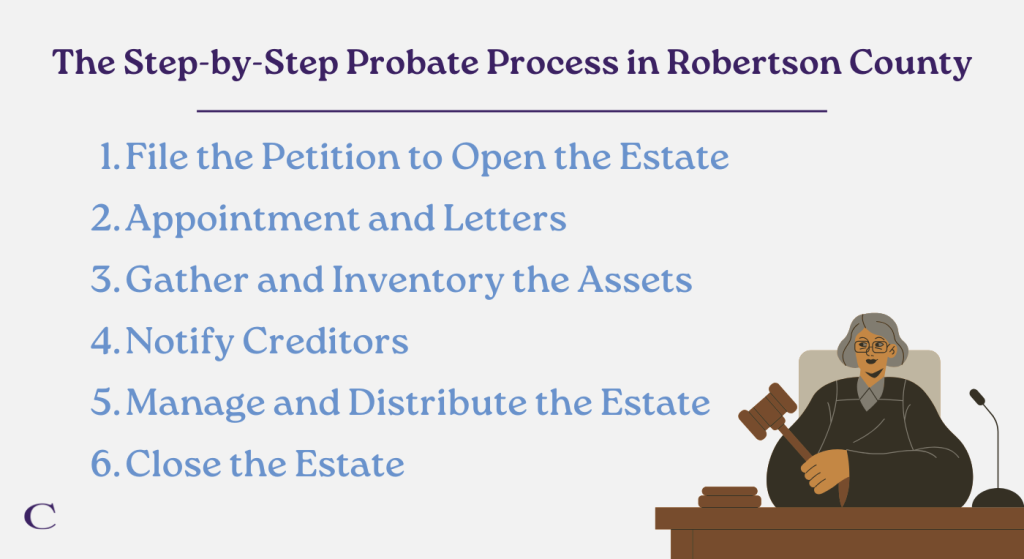
The Step-by-Step Probate Process in Robertson County
Once probate is necessary, the Robertson County Chancery Court follows a predictable sequence.
Step 1: File the Petition to Open the Estate
Everything begins with filing a petition at the Robertson County courthouse in the Chancery Court to open the estate.
If there’s a will, we submit the original will and a petition to probate it. If there isn’t a will, we file a petition for administration under Tennessee’s intestacy laws. Either way, we’re asking the court to formally appoint someone, typically a spouse or adult child, to act as the personal representative.
In many cases in Robertson County, a hearing may be required in order to open an estate. Whether a hearing will be set is determined by the Chancellor. The Court reviews the pleadings in advance, and if the Chancellor concludes that a hearing is necessary, the Clerk and Master of Robertson County, Jon Graves, will notify counsel or the parties accordingly. There is no fixed standard governing when a hearing will be required; the decision rests entirely within the Chancellor’s discretion.
Step 2: Appointment and Letters
Once appointed, the personal representative receives Letters Testamentary (with a will) or Letters of Administration (without one).
These documents are critical. They’re essentially the key that unlocks everything else. Banks in Springfield, title companies, and financial institutions will not even talk to you without those letters. With them, you can access accounts, list property for sale, and act on behalf of the estate.
I tell clients: this is the moment you officially have authority to do the work.
Step 3: Gather and Inventory Assets
Next comes what I call the “information-gathering phase.” We identify everything the person owned—bank accounts, real estate, vehicles, personal property, retirement funds, and debts. Then, we prepare an inventory and assign date-of-death values.
In Robertson County, this is where local knowledge really helps. I work directly with local banks, realtors, and appraisers. Because it’s a smaller community, these relationships tend to make things smoother and faster.
Step 4: Notify Creditors
Tennessee law requires us to publish a notice to creditors and allow a claims period.
We run the required notice and also send direct notice to known creditors. This notice can be run in a local paper such as the Robertson County Times or the Robertson County Connection. Then we wait out the four-month statutory window. During that time, creditors may file a claim against the estate. If filed, the personal representative may challenge the claim, by filing what is known as an exception to the claim.
If no claims are filed, creditors generally can’t come back later after the four-month period and demand payment after distributions have been made.
Step 5: Manage and Distribute the Estate
After debts, taxes, and expenses are handled, the personal representative distributes what remains according to the will or Tennessee intestacy law if there is no will. Sometimes this is simple. For example, the personal representative must divide a bank account among three children.
Other times, especially here in Robertson County where families often inherit land that’s been owned for generations, it can mean coordinating sales, deeds, or buyouts between siblings. This is where careful planning prevents family disputes.
Step 6: Close the Estate
Finally, we prepare the documents to close the estate. Typically, these documents include a final accounting and a petition the court to close the estate. Once approved, the personal representative is discharged, and the estate is officially finished.
Most uncontested estates in Springfield take several months to about a year, depending largely on creditor timelines and how quickly information is gathered. I’ve come to see probate less as a legal battle and more as project management with court oversight. When handled methodically and locally, it’s orderly, predictable, and far less intimidating than people expect.
How Estates Commonly Gets Delayed in Robertson County
In Robertson County, most delays aren’t legal problems, rather they’re practical problems.
Very rarely does an estate in Springfield get stuck because of some complicated courtroom dispute or obscure legal rule. Instead, the slowdowns usually come from everyday issues: missing paperwork, family disagreements, unclear titles, or simply not understanding what the court requires.
When clients ask me how long probate will take, I’m honest with them. A straightforward estate can move steadily through the Robertson County probate court. But certain recurring issues almost always add months. After seeing the same patterns over and over, I can usually predict the bottlenecks before we even file.
Here are the delays I see most often in my local practice:
Real Estate Title Problems
This is probably the number one culprit in Robertson County. Unlike larger metro areas, a lot of property here has been in families for generations.
I regularly encounter land that passed from parent to child informally, sometimes without a recorded deed, or with multiple heirs listed, or even still in the name of someone who died 20 or 30 years ago. From a family perspective, everyone “knows” who owns the property. From a legal perspective, the title is a mess.
Before we can sell or transfer family land, we may need:
- Heirship affidavits
- Corrective deeds
- Multiple probate estates opened
- Or cooperation from relatives scattered across different states
Each extra step adds time. I’ve had estates that should have closed in six months stretch past a year simply because we were untangling old land records.
Missing Information and Disorganization
Another common delay is simply not knowing what the decedent owned. Families come in with shoeboxes of mail and no clear list of accounts. We spend weeks tracking down banks, insurance companies, and retirement plans. Sometimes statements are outdated or passwords are lost.
Probate moves much faster when someone has kept even a basic asset list. Without it, we’re essentially doing detective work. In a smaller community like Springfield, we can often track things down, but it still takes time.
Family Disagreements
Most families get along. But grief has a way of reopening old tensions. Even minor disputes can stall an estate:
- Arguments about who should serve as executor
- Disagreements over selling the family home
- Fights about sentimental personal property
- Suspicion about how money is being handled
The court generally won’t step in unless necessary, which means the estate often pauses while the family works it out or while I try to broker a practical compromise. In my experience, indecision causes more delay than actual litigation.
Creditor and Claims Issues
Sometimes delays are procedural. We have to wait out Tennessee’s creditor claims period, and unfortunately, that timeline isn’t optional. Even if everything else is ready, we can’t safely distribute assets until that window closes.
Occasionally, disputed medical bills or unexpected claims also require negotiation or court approval. That can slow things down, but it’s part of protecting the executor from future liability.
Inexperience With the Process
Finally, I see delays when families try to handle everything themselves without understanding the court’s expectations. Robertson County Chancery Court is efficient, but it’s still particular. Incorrect filings, incomplete inventories, or missed deadlines mean paperwork gets rejected and has to be redone. That costs weeks each time.
When I’m involved early, we usually avoid those setbacks entirely because we’re doing it right the first time.
My conclusion is simple: probate delays are generally preventable. Organization, clear communication, and familiarity with local practice make an enormous difference. Most estates don’t get stuck because the law is complicated. They get stuck because the details weren’t handled early.
How Much Does Probate Typically Cost in Robertson County?
Probate costs vary depending on:
- Court filing fees (typically $454.50 to open, plus additional fees for filings)
- Attorney involvement and complexity
- Real estate issues
- Creditor disputes
Simple estates are often less expensive than families expect, while estates involving land and title cleanup can require additional work. In our practice, we see most attorneys in the Robertson County area charge hourly, around $300 per hour. Other firms, like ours, charge flat rate fees so you know what the total attorney fee will be, from beginning to end. We find this flat fee helps reduce the uncertainty of an hourly rate and prevents attorneys from padding their time.
Small estate procedures can significantly reduce costs when applicable.
Frequently Asked Questions About Probate in Springfield, Tennessee
How long does probate take in Robertson County?
Most uncontested full probate estates take six months to about a year. If the case is going over a year long, there are usually issues or complexities with the case.
Do I need a probate attorney in Springfield, TN?
While not legally required, having a local probate lawyer usually saves substantial time, prevents mistakes, and avoids delays. Most of our
Can probate be avoided in Tennessee?
Yes, through proper asset titling, trusts, and beneficiary designations. If you are interested in avoiding probate, a revocable living trust is a great alternative and helps streamline your estate when you pass away.
What happens if there is no will?
Tennessee intestacy laws determine who inherits. As we like to say, if you do not have a will then the State of Tennessee has a will for you.
Need Help With Probate in Robertson County?
If you’ve recently lost a loved one and aren’t sure whether probate is required, or you’re already dealing with the process, working with a probate attorney in Springfield who regularly practices in the Robertson County Chancery Court can make all the difference.
At Crow Estate Planning & Probate, PLC, we guide families across Robertson County through probate efficiently and with care. Schedule a free consultation today for clear answers and a plan forward.
About the Author
Noah Darden is a licensed attorney with Crow Estate Planning & Probate, PLC. He joined Crow in 2026, bringing his experience of the probate system directly from the Seventh Circuit Court for Davidson County to our firm. After graduating with his Bachelor of Arts degree from the University of Tennessee at Chattanooga, he earned his Juris Doctorate from Belmont University School of Law, where he also served as the Senior Editor of the Belmont Law Journal. He’s proud to assist the greater Montgomery County and Robertson County communities with their estate planning and probate needs. Learn More.
Licensed in Tennessee