

After the loss of a loved one, families are often still grieving when the word probate enters the picture, raising questions about what it is, what is required, and how long the process will take. In Davidson County, there are clear and defined procedures in place designed to yield a streamlined process.
When Probate is Required Under Tennessee Law
Probate in Tennessee is the court-supervised process of settling a deceased person’s estate by validating a Will (if one exists), paying debts, and distributing assets to the proper heirs or beneficiaries. Assets that are jointly owned, or those that have a designated beneficiary do not have to go through probate. This process is only required for assets that are titled solely in the name of the decedent, with no beneficiary specified.
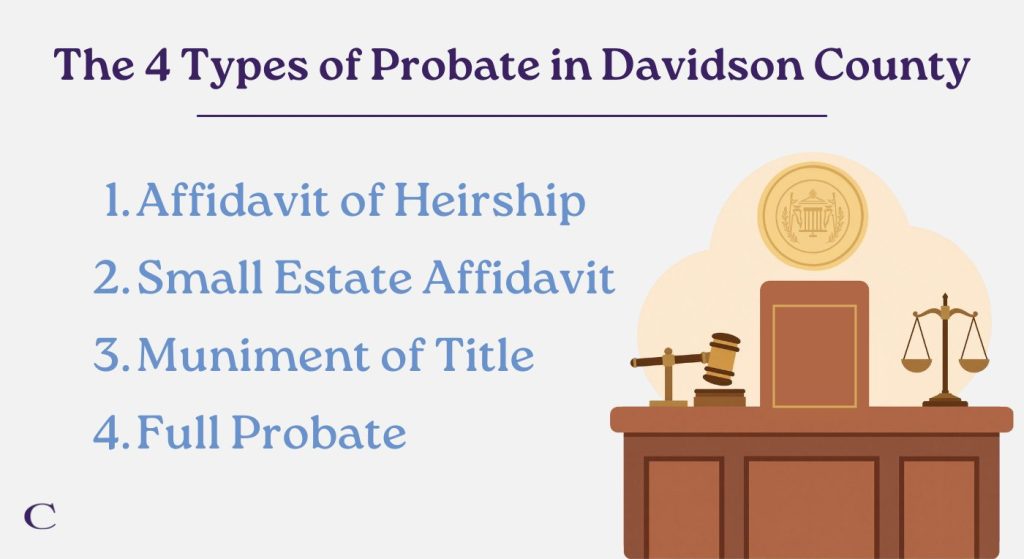
There are several types of probate prescribed under Tennessee law. The applicable probate proceeding depends on the specific assets the decedent possessed in their name at the time of their death.
Affidavit of Heirship in Tennessee
If the decedent did not have a Will, and the only asset in their name was a piece(s) of property, an affidavit of heirship is appropriate. Unlike the other types of probate mentioned below, this does not require any court filings. This serves to merely transfer the title of the real property from the decedent’s name to the name(s) of their heir(s). Once this is recorded with the register of deeds, it acts as the new deed for the property.
Small Estate Affidavit in Tennessee
If the decedent left an estate valued at $50,000 or less, it qualifies for a small estate affidavit. These can be used with or without a Last Will and Testament.
Muniment of Title in Tennessee
If the decedent had a Will, and the only asset in their name was a piece(s) of property, a muniment of title is appropriate. This serves as the new deed for the property, showing that the new owners of the property are vested with title to the real estate.
Full Probate in Tennessee
If the decedent left over $15,000 in personal property and owned real estate or if the decedent left over $50,000 in personal property, with or without real estate, a full probate administration is required. Akin to small estates, full probates can apply with or without a Will.
What Probate Actually Looks Like in Davidson County
As Tennessee’s largest county, Davidson County probate court has several sophisticated systems in place to tackle the large volume of probates filed. There are a few key members of the Court that you may encounter while going through a probate proceeding in Davidson County.
- Judge Andra Hedrick was elected to the bench in 2022. She presides over the Seventh Circuit Court and oversees all proceedings within the probate court. On a day-to-day basis, Judge Hedrick hears all probate openings, as well as the Motion docket, which includes anything from basic Motions for Attorney Fees to complex, disputed matters.
- Probate Master Elizabeth Johnson reviews all accountings, inventories, and hears status conferences on estates that have been open for an extended time.
- Special Master Judith Lojek hears all creditor claims, small estates, and sometimes assists Judge Hedrick with full probate estate openings.
The Step-by-Step Probate Process in Davidson County
As mentioned, probate looks different depending on the type of assets the decedent owned. While there is some overlap, each process has its own unique steps. Here’s a step-by-step process of how the three main types of probate—small estate affidavits, muniments of titles, and full probates—operate in Davidson County.
Small Estate Affidavits in Davidson County
For our first example, let’s look at an individual passes that away with a valid Last Will and Testament and was a resident of Davidson County. Remember, small estate affidavits can also apply if the decedent did not have a Last Will and Testament, but assume the decedent had one for the purposes of this example.
The total value of the decedent’s estate requiring probate must be $50,000 or less.
The Executor waits 45 days after the decedent’s date of death.
Through counsel, the Executor files the small estate affidavit with the Court alongside the original Will, death certificate, and consents/waivers to bond, inventory, and accounting from all heirs and beneficiaries. Under Tennessee law, bond (an insurance policy for the Personal Representative designed to protect the heirs/beneficiaries of the estate), inventory (an itemization of assets in the estate), and accounting (a detailed breakdown of all deposits and withdrawals from the estate account throughout the duration of the probate) are required unless a Will waives them or all heirs/beneficiaries file written consents waiving them. Differing from the full probate process, in a small estate proceeding, consents/waivers are required even if the Will includes this waiving language.
In the small estate affidavit, the Executor must estimate the decedent’s assets and liabilities. Additionally, the Executor must list all beneficiaries of the Will and heirs-at-law of the decedent, even if they are not the same. In Tennessee, your heirs-at-law are those who would inherit your estate if you did not have a Will—think, your next of kin. Typically, the beneficiaries of a Will are the same as one’s heirs-at-law, but this is not always the case. Accordingly, all must be identified in the small estate affidavit to ensure they are put on notice of the court proceeding and give the opportunity to object to or contest the Will, should they find it necessary.
Counsel attends a hearing in front of Special Master Lojek. In Davidson County, the Executor does not necessarily have to be present at Court hearings, particularly estate openings; however, it is always a good idea to attend alongside counsel to answer any of the Court’s questions that may be specific to the Decedent or their heirs. Any interested party is welcome to attend said hearings but is not required to. While the Court regularly permits attorneys to appear by Zoom, non-attorneys are not typically permitted to testify via Zoom, but they may always join by Zoom to merely observe.
The Executor then receives Limited Letters from the Court, and uses them to obtain access to the decedent’s bank accounts and any other assets in the decedent’s name to transfer all funds into an estate bank account.
The Executor must pay any known debts of the decedent, then make the final distributions from the estate bank account pursuant to the Will.
Muniments of Title in Davidson County
In this example, an individual passes away with a valid Last Will and Testament and was a resident of Davidson County. The decedent’s sole asset requiring probate is a piece of real property.
Through counsel, the Executor files the petition to probate for muniment of title only with the Court alongside the original Will and death certificate. The petition, like the small estate affidavit, must identify the beneficiaries under the Will as well as the decedent’s heirs-at-law. The petition should also include a legal description of the decedent’s real property, akin to what you would find on a deed.
Counsel attends a hearing in front of Judge Hedrick. Then, the Executor receives the signed order approving muniment of title and declaring the new owners of the property from the Court.
Counsel records the order and court-certified copy of the Will with the register of deeds in the county where the property is located. This acts as the new deed for the property, reflecting that title to the real estate has vested in the new owners.
From here, the new owners of the property may keep or make changes to the real estate; however, most title companies will not permit the sale of the real estate for at least six months after the decedent’s date of death.
Full Probates in Davidson County
Finally, let’s look at an individual who passes away without a valid Last Will and Testament and was a resident of Davidson County. Like small estate affidavits, full probates frequently take place with a valid Will, but for this example, we’ll assume the decedent did not have one, making this an intestate probate.
Recall that the decedent can either own $15,000 in personal property and real estate or over $50,000 in personal property, with or without real estate for full probate. In this example, the total value of the decedent’s personal property is $30,000, and decedent owned real property in Davidson County.
Since the decedent did not leave a Will, there is no pre-designated Executor to take care of probate proceedings. Accordingly, the Court must appoint an Administrator. Technically, anyone can petition to become the Administrator, but more often than not it is the decedent’s next of kin, whom we call the Petitioner.
Through counsel, the Petitioner files the petition to probate, asking the Court to open the estate and to be appointed as Administrator. This petition must include a few key elements.
First, the Petitioner must identify the decedent’s heirs-at-law. When an individual dies in Tennessee without a Will, the laws of intestacy dictate who inherits their assets:
- If the decedent was married and had no children, their spouse receives 100% of their estate.
- If the decedent was married and had children, their spouse and children split the estate.
- However, the spouse can receive no less than 1/3rd. Meaning, if the decedent had a spouse and two children, each person would receive 1/3rd of the estate, but if the decedent had a spouse and three children, the spouse would receive 1/3rd, and the children would split the remaining 2/3rds of the estate (each child would receive 2/9ths).
- If the decedent did not have a spouse nor children, their parents inherit the estate in equal shares.
- If the decedent’s parents predeceased them, their siblings inherit the estate. This is typically as far down the intestacy tree we must go, but the law also provides for even more attenuated situations.
Second, the Petitioner must give the Court an estimate of the total estate value.
Finally, the Petitioner must affirm that they have not been convicted of a felony. This often disqualifies individuals from serving as an Administrator. And yes, even if it was 20 years ago, it still discounts your ability to serve, unfortunately!
Along with the petition to probate, the Petitioner must file:
- The death certificate
- Consents/waivers to bond/inventory/accounting discussed earlier
- An oath to serve as administrator
- A cost bond confirming the responsibility to pay court filing fees
- A non-resident fiduciary form, if they are not a resident of Tennessee
Sometimes, after filing all required documentation, Judge Hedrick will go ahead and sign the order opening other estate. This is common in straight forward probate proceedings, particularly when there are only one or two heirs-at-law. Otherwise, the Petitioner’s counsel will attend the initial hearing in front of Judge Hedrick, where she’ll sign the order opening the estate and appointing the Petitioner as the Administrator.
The Administrator then receives Letters of Administration from the Court, which will be used to obtain access to the decedent’s bank accounts and any other assets in the decedent’s name. Then, the Administrator must transfer all funds into an estate bank account, and begin selling any assets belonging to the decedent not desired by any of the heirs. Any money obtained from the sale of said items must be deposited into the estate account.
After the estate has been officially opened with the Court, which is marked by the opening order, a four-month creditor period begins. The Court issues a notice in the local paper, putting any creditors of the decedent on notice. Creditors then have four months to file claims against the estate. The Administrator can either pay said claims or ask their counsel to file exceptions to the claims, which typically results in their denial.
After the four-month creditor period lapses, counsel completes an affidavit of heirship transferring the real property belonging to the decedent to the names of the heirs-at-law. This is recorded with the register of deed’s office and serves as the new deed for the property.
The Administrator makes the final distributions from the estate bank account to the heirs-at-law. The Administrator and all heirs-at-law sign distributee statements confirming that they have received all they are entitled to. Finally, the Administrator’s counsel files all signed distributee statements along with the order to close with the court. Once this order is signed by the Judge, the estate is officially closed.
Where Estates Commonly Get Delayed in Davidson County
The length of probate differs significantly depending on the type of proceeding required. For example, small estate affidavits are typically completed within a matter of weeks, while full probate administrations take a minimum of six months. There are a few common reasons why estates get delayed:
Disagreement Amongst Heirs and/or Beneficiaries
Disputes between heirs or beneficiaries are one of the most common causes of delay in probate. Typically, these disagreements involve the interpretation of or surprises within a Will and objections to the appointment of an Executor or Administrator. When conflicts arise, the Court may require additional filings, hearings, or mediation before the estate can move forward. In Davidson County, contested matters can significantly extend the timeline of an otherwise routine probate case.
Lack of Records
Probate relies heavily on accurate and complete documentation. Missing original Wills, unclear asset ownership, or outdated records of beneficiary designations can slow the administration of an estate. Delays also commonly occur when court-ordered accountings are deficient; this could mean incomplete estate account records, missing copies of checks, or a lack of receipts from the sale of an estate asset. Without clear records, additional time is required to gather information, correct deficiencies, or respond to court requests before the estate can move forward.
Tips For Preparing for a Davidson County Probate
If you recently lost a loved one who lived in Davidson County and are now tackling probate, there are a few steps you can take to make the process smoother on all parties.
Communication Reduces Conflict
Whether you are working with an attorney or tackling a probate on your own, it is important to maintain active communication with all interested parties in the estate, as well as the Court. One of the most common frustrations for heirs of an estate is a lack of knowledge regarding the status of the estate, what steps remain, and ultimately, when they can expect to receive the assets they’re entitled to. Explaining decisions, setting expectations, and addressing potential concerns in advance can reduce the likelihood of objections and contested matters during probate.
Trust Planning to Avoid Probate
Involvement in a probate in any capacity often inspires many people to re-evaluate their own estate planning. For most families, a properly funded trust can minimize or eliminate the need for probate altogether. In Davidson County, this can reduce administrative steps, shorten timelines, and provide greater privacy for the family.
Contact a Trusted Davidson County Probate Attorney Today
If you’ve recently lost a loved one and aren’t sure what form of probate is required, or you’re already dealing with the process, working with a probate attorney in Nashville who regularly practices in Davidson County Chancery Court can make all the difference in your case.
At Crow Estate Planning & Probate, PLC, we assist families across Davidson County through probate efficiently and with care. Schedule a free consultation today for clear answers and a plan forward.
About the Author
Attorney Alexandra Hulme joined Crow Estate Planning & Probate, PLC in 2023. After graduating summa cum laude with her Bachelor of Science in Criminal Justice and Political Science from Texas Christian University, she went on to earn her Juris Doctorate from Vanderbilt Law School. She is a Nashville native that’s proud to serve her hometown in the areas of probate, conservatorships, guardianships, estate planning, estate administration, and litigation. Learn More.
Licensed in Tennessee