Business Lawyer in Chattanooga, TN

Back to Locations

A business lawyer in Chattanooga, TN helps companies navigate the legal decisions that determine whether they hold together under pressure or begin to break. Most businesses do not fail because of a lack of effort or opportunity. They fail because the legal foundation underneath them was never built to support growth, conflict, or transition.

Chattanooga’s business community has evolved significantly over the past two decades. A city once defined by manufacturing and logistics now supports a diverse mix of technology companies, healthcare organizations, professional service firms, and family-owned businesses moving into a second or third generation. That evolution has brought opportunity, but it has also made the legal environment more complex. The gap between businesses with a deliberate legal structure and those operating without one is no longer subtle. It is often the difference between stability and exposure.

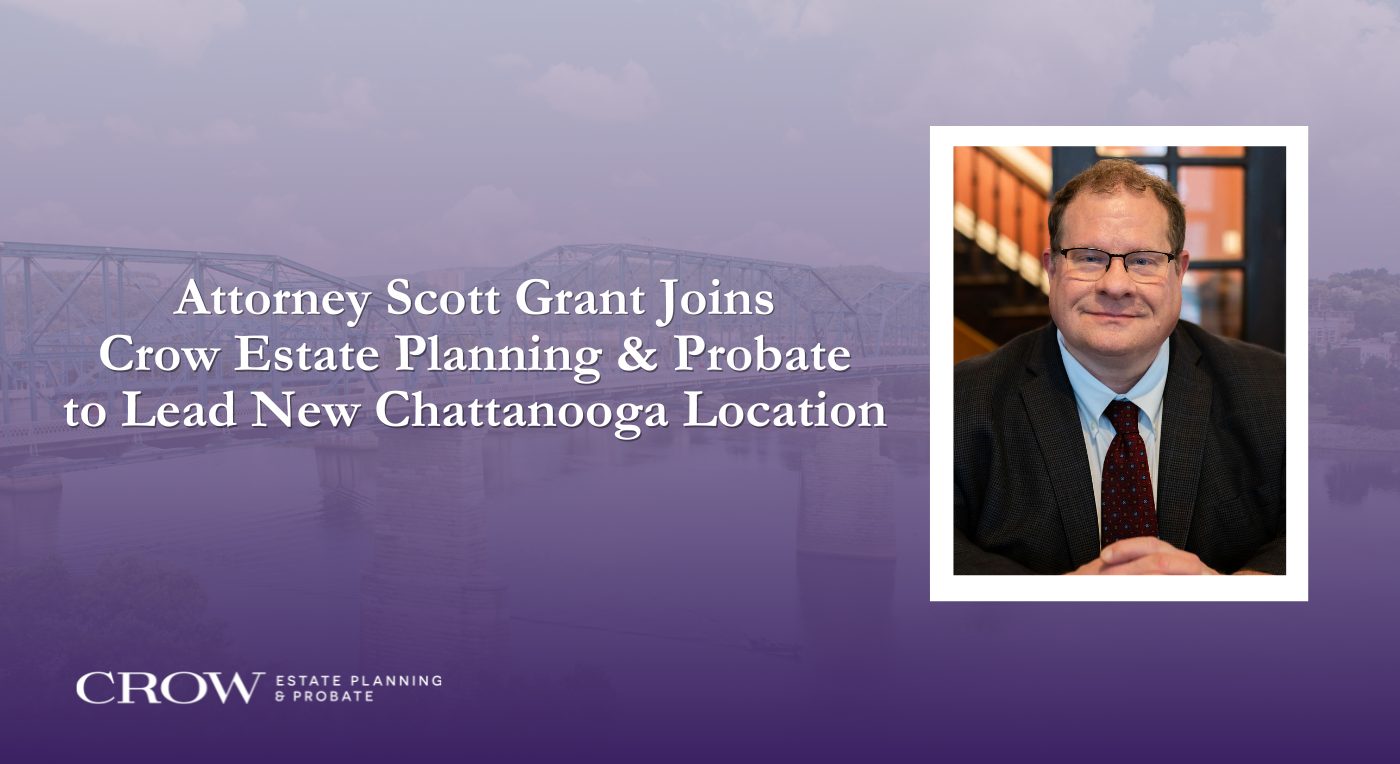
At Crow Estate Planning and Probate, Scott Grant works with business owners throughout Chattanooga and Hamilton County on the legal issues that actually determine long term success. That includes structuring companies correctly from the outset, documenting the relationships that hold a business together, planning for ownership transitions before they are forced, and integrating business assets into a broader estate and asset protection strategy. 

This page explains how our business law practice serves Chattanooga companies and what you can expect when you work with us.

The Legal Foundation Most Chattanooga Businesses Are Missing

Most business owners are exceptionally good at what they do. They understand their industry, their customers, and the day to day demands of running a company. Legal structure is rarely where they focus their time, and it shows.

The most common business legal problems we see in Chattanooga are not complex or unusual. They are foundational gaps that have existed since the beginning, unnoticed until something forces them into the open. For example:

  • A business formed as an LLC without an operating agreement is exposed in ways the owner often does not understand. 
  • Two partners who built a company on a handshake may work well together for years, until a disagreement over direction or compensation reveals there was never a shared understanding in the first place. 
  • A contractor relying on a decade old client agreement, never reviewed under current Tennessee law, may not realize what they have actually agreed to until a dispute arises.

These problems are predictable. They are also avoidable. The issue is timing. Legal gaps tend to stay quiet until the moment they matter, and by then, the leverage is gone and the options are narrower.

The businesses that navigate growth, conflict, and transition successfully are the ones that built their legal framework deliberately from the outset. That does not mean complexity. It means clarity. It means putting the right agreements in place when relationships are strong, not when they are breaking down.

Scott works with Chattanooga business owners to identify these gaps early and correct them before they become expensive problems. In practice, that is often the difference between a manageable issue and a dispute that disrupts the business.

Business Formation: Getting the Structure Right from the Start

The entity you choose when forming a business determines how it is taxed, how it is governed, how liability flows, and how ownership can be transferred. Those consequences do not stay theoretical. They follow the business for as long as it exists.

Selecting the wrong entity is one of the most common and expensive mistakes we see. It is rarely obvious at formation. It becomes obvious later, when fixing it requires restructuring, additional cost, and in some cases, avoidable tax consequences.

Limited Liability Companies

For most small and mid-sized businesses in Chattanooga, the limited liability company (LLC) is the default choice. When properly structured and maintained, it provides personal liability protection, flexibility in management, and control over how profits are distributed without the formalities required of a corporation.

Where LLCs most often fail is not in formation, but in governance.

Formation documents do not define how owners actually work together. That is the role of the operating agreement. It governs how decisions are made, how profits and losses are allocated, what happens when an owner exits, and how disputes are resolved.

Without an operating agreement, Tennessee law supplies default rules. Those rules are rarely what the owners intended and almost never what they would choose if forced to address the issue directly. For any LLC with more than one member, a well-drafted operating agreement is essential.

Corporations and S-Corporations

Corporations are typically appropriate for businesses that plan to raise outside capital, issue multiple classes of ownership, or position themselves for a sale or public offering. They come with more formal requirements, including a board of directors, required meetings, and ongoing recordkeeping. Those formalities are not just administrative. They are part of what preserves the liability protection the structure is designed to provide.

An S-corporation election can offer tax advantages in the right circumstances, but it is not a default solution and it is frequently misunderstood. Choosing between an LLC and a corporation, and selecting the appropriate tax treatment, should be coordinated with both legal and tax advice at the outset, not revisited after problems arise.

Partnerships and Limited Partnerships

General partnerships and limited partnerships are more specialized structures, often used in real estate and investment contexts. A general partnership provides no liability protection to its partners, which makes additional planning critical. A limited partnership allows passive investors to participate without personal liability while a general partner retains control.

These structures can be effective when used correctly, but they depend heavily on well-drafted partnership agreements that address governance, profit allocation, and the mechanics of ownership changes. Without that documentation, the same issues that affect LLCs appear here, often with greater exposure.


Contracts: The Operating System of Your Business

If the entity structure is the legal foundation of a business, contracts are its operating system. They govern every meaningful relationship the company has: with clients, vendors, employees, contractors, landlords, lenders, and partners. When those relationships are tested, and they will be, the contract determines what happens next.

Chattanooga business owners often come to us after signing agreements they did not fully understand or after a dispute surfaces in a document that was pulled from the internet or borrowed from another business years earlier. Those agreements are rarely written for Tennessee law, are not tailored to the specific relationship, and often contain provisions the business owner would have rejected if they had been clearly explained at the outset.

In practice, these are the agreements that most often determine whether a problem stays manageable or becomes expensive:

  • Operating and partnership agreements that define ownership, control, and profit distribution
  • Buy-sell agreements that govern ownership transitions due to death, disability, or disagreement
  • Client and vendor contracts that set expectations and allocate risk
  • Employment and independent contractor agreements that protect the business and comply with Tennessee law
  • Non-disclosure and non-compete agreements that protect confidential information and relationships
  • Commercial leases that can create long-term financial obligations if not negotiated carefully

Contract disputes are one of the most common reasons businesses end up in litigation. Most of those disputes are not caused by unpredictable events. They are caused by unclear, incomplete, or poorly drafted agreements.

Well-drafted contracts do not eliminate conflict, but they change the outcome. A business with clear, enforceable agreements is in a stronger position to resolve disputes quickly and on favorable terms. A business without them is often left trying to reconstruct expectations from emails, assumptions, and memory.

Business Succession: The Question Most Owners Avoid

Business succession is where the stakes are highest and the planning gap is widest. For many Chattanooga business owners, the company is the most valuable asset they own. It is also the asset most likely to lose value quickly if ownership transitions poorly.

Most owners know they need a plan. Few actually have one. Fewer still have documented how ownership should transfer if they become incapacitated or die unexpectedly.

Succession planning is not limited to death or retirement. It applies to any ownership change: a partner buyout, a sale to a third party, a transfer to family members, or a management buyout. Each scenario carries different legal and tax implications. The owners who think through those transitions in advance, and put them in writing, protect both the business and the people who depend on it.

A buy-sell agreement is the cornerstone document for any business with multiple owners. It establishes when an ownership interest can be sold, who has the right to purchase it, how the business is valued, and how the transaction is funded.

Without a buy-sell agreement, the results are often predictable and problematic. A partner’s death can leave an ownership interest to an heir who does not want it and cannot operate the business. The remaining owners may be forced into a buyout they are not prepared to fund or into a sale at exactly the wrong time. With a properly structured agreement, those outcomes are avoided and the transition follows terms the owners agreed to in advance.

For Chattanooga families with a business that may pass to the next generation, succession planning and estate planning must be built together. Most firms treat these as separate issues. For business owners, that separation is where problems begin.

How the business is owned, how it is valued, and how it transfers at death or incapacity directly affects estate tax exposure, probate administration, and long-term financial security. Scott’s practice covers both business law and estate planning, which means these plans are designed to work together rather than conflict when they are needed most.

Mergers and Acquisitions

Chattanooga’s growing business community continues to generate a steady flow of transactions. Established companies acquire competitors or suppliers. Owners sell businesses they have spent years building. Investors step into companies with strong fundamentals but limited capital. Each of these deals carries significant legal and financial consequences, and the terms negotiated in the transaction documents ultimately determine the outcome.

On the buyer side, effective representation begins with due diligence. That includes a detailed review of the target company’s contracts, liabilities, ownership structure, regulatory compliance, and any pending or potential disputes. A business that appears clean at a high level often is not. Hidden liabilities, poorly drafted agreements, or unresolved issues can quickly become the buyer’s problem after closing.

The primary protections for a buyer are found in the diligence process and in the representations and warranties built into the purchase agreement. When those are handled correctly, they allocate risk appropriately. When they are not, the buyer inherits problems they did not intend to purchase.

On the seller side, the focus shifts to maximizing after-tax proceeds while controlling post-closing exposure. The structure of the transaction, along with provisions such as purchase price adjustments, indemnification obligations, earn-outs, and non-compete agreements, can materially affect what the seller actually receives and what risks remain after the deal is done.

One of the most common mistakes we see is bringing legal counsel into the process too late. By the time draft documents are circulating, many of the most important terms have already been set. Involving experienced counsel at the beginning of a transaction, rather than at the end, gives both buyers and sellers the ability to shape the deal instead of reacting to it.

Business Disputes and Commercial Litigation in Chattanooga

Even well-run businesses with strong legal foundations face disputes. A client refuses to pay. A vendor fails to deliver. A former partner claims an ownership interest. An employee raises a legal issue. These situations are not unusual. What matters is how they are handled and how early experienced counsel becomes involved.

The difference between a contained problem and a company-level disruption is often timing and strategy. Missteps early in a dispute, whether in communication, documentation, or positioning, can narrow options quickly and make resolution more difficult and more expensive.

Scott represents business clients in commercial disputes involving contract claims, partnership disagreements, shareholder conflicts, and business interference claims in Hamilton County courts and, where appropriate, in federal court. His approach begins with a clear assessment of the legal merits, the cost of litigation, and the business objectives that actually matter. Litigation is not the default. It is one tool among several, and it should be used deliberately.

Many disputes that ultimately reach court could have been resolved earlier and at lower cost. In practice, those opportunities are often missed because the issue was not addressed early or was approached without a clear legal strategy. Scott identifies opportunities for resolution through negotiation or mediation when they align with the client’s interests and pursues them directly.

When litigation is necessary, it is handled with the same level of preparation and discipline applied to every other aspect of the practice. That includes building the case early, understanding the opposing position, and moving the matter forward with a clear objective rather than reacting to each development as it arises.

Why Business Law and Estate Planning Belong Together

For most business owners in Chattanooga, the business and the personal estate are inseparable. The company is often the primary source of income, the largest asset, and the mechanism through which wealth transfers to the next generation. Despite that, business law and estate planning are often handled separately, creating gaps where the two plans should align.

Those gaps tend to surface at exactly the wrong time.

When a business owner’s estate plan does not account for the business, the consequences are rarely minor. Ownership can pass to heirs who are not prepared to operate the company. Estate taxes can force the sale of business assets under pressure. Probate can delay decision-making and disrupt operations. A trust may hold the ownership interest in a way that conflicts with the company’s governing documents.

These are not edge cases. They are common outcomes when business and estate planning are handled in isolation.

Scott’s practice is built around integrating both. The ownership structure, succession plan, estate plan, and asset protection strategy are developed together so they function as a single system rather than a collection of disconnected documents.

For Chattanooga business owners who have built something of real value, that coordination is not a refinement. It is the difference between a transition that preserves the business and one that puts it at risk.

Working With a Chattanooga Business Attorney

Scott Grant is a Chattanooga native who has spent his career working with the individuals and businesses that drive this local economy. His practice is built around companies that are actively growing, transitioning, or dealing with real legal exposure. That includes family-owned businesses navigating ownership changes, professional service firms managing risk and compliance, entrepreneurs forming and funding new ventures, and established companies handling transactions or disputes.

Every engagement begins with a clear assessment of the business itself, not just the immediate legal question. The right answer to a formation issue depends on the owner’s goals, tax position, industry, and long-term plans. The right approach to a dispute depends on what the business actually needs, not just what the law allows. That context drives the strategy from the outset.

Scott is also direct about scope. When a matter falls outside his practice, he says so and helps the client find the right resource. When it falls within his practice, clients can expect preparation, responsiveness, and legal work designed to hold up under scrutiny, whether in a transaction, a dispute, or a long-term planning structure.

Our Chattanooga business law practice assists clients with:

  • Business formation, entity selection, and governing document drafting for LLCs, corporations, and partnerships
  • Contract drafting and review across all stages of business operations
  • Buy-sell agreements and business succession planning
  • Mergers, acquisitions, and business sale transactions
  • Commercial disputes and business litigation in Hamilton County and federal courts
  • Asset protection planning integrated with business structure
  • Estate planning coordinated with business ownership and succession
  • Business owner elder law and long term care planning for owners approaching retirement

Frequently Asked Questions About Business Law in Chattanooga, TN

It is not too late, and it is almost always worth doing. An operating or partnership agreement created after the business is established reflects how the business actually operates today, including ownership percentages, roles, and expectations, rather than assumptions made at the start.

Most partners realize they needed an agreement when a disagreement arises. Putting one in place before that point is far easier than negotiating terms after trust has started to break down.

Piercing the corporate veil occurs when a court disregards the legal separation between a business and its owners and holds the owners personally liable for business obligations.

This typically happens when owners fail to treat the business as a separate entity, such as commingling personal and business funds, failing to follow required formalities, or using the company for personal purposes.

Avoiding it requires consistent separation: dedicated accounts, proper documentation, and operating the business as an independent legal entity in both form and practice.

Most acquisitions follow a structured process: letter of intent, due diligence, negotiation of definitive agreements, and closing.

Due diligence is where risk is uncovered. That includes reviewing contracts, financials, employment matters, regulatory compliance, intellectual property, and potential claims. That information shapes the representations and warranties in the purchase agreement, which are the buyer’s primary protections.

Getting legal counsel involved before signing a letter of intent, not after, gives both sides more control over the structure and terms of the deal.

Business interests must be addressed directly in an estate plan. The approach depends on the entity structure, the existence of a buy-sell agreement, and the family’s goals for the business.

Ownership interests can typically be transferred through a will or trust, but those transfers must align with the company’s governing documents. A buy-sell agreement may control or restrict who can receive the interest.

For operating businesses, a revocable trust is often the most efficient structure because it avoids probate and allows continuity if the owner becomes incapacitated or passes away. For higher-value businesses, estate tax exposure must also be evaluated.

A buy-sell agreement defines how ownership changes occur and how they are handled.

It should address triggering events such as death, disability, retirement, voluntary exit, divorce, and involuntary transfer. It should also establish who can purchase the interest, how the business is valued, how the purchase is funded, and the timeline for completing the transaction.

Without a clear agreement, ownership transitions often create uncertainty, disputes, and financial pressure at the worst possible time.

The starting point is understanding the contract and the strength of your legal position. Many disputes are more complex than they initially appear, and early missteps can weaken a strong claim.

Depending on the situation, resolution may occur through negotiation, mediation, or litigation. Early involvement of legal counsel improves outcomes by avoiding procedural mistakes and positioning the dispute correctly from the outset.

Business law governs how your company operates during your lifetime, including structure, contracts, disputes, and transactions. Estate planning governs how your assets, including your business, are managed during incapacity and transferred at death.

For most business owners, the two are closely connected. The structure and ownership of the business directly affect how it passes and how it is taxed. Working with an attorney who handles both ensures those plans are coordinated rather than conflicting.

Contact a Chattanooga Business Attorney Today

The businesses that succeed over the long term are not always the ones with the best products or the most talented teams. They are the ones built on a legal foundation that can support growth, absorb conflict, and handle transition without breaking.

That foundation is built before business disputes or problems arrive.

Scott Grant and the law firm of Crow Estate Planning and Probate work with business owners throughout Chattanooga, Cleveland, and Hamilton County to identify risk early, structure businesses correctly, and put the right agreements in place before problems surface.

If you want a clear understanding of where your business is exposed and what should be addressed, schedule a consultation with our Chattanooga office. We will assess your current structure, identify gaps, and outline practical steps to strengthen your position going forward.

CONTACT US CALL OUR CHATTANOOGA OFFICE
A high-angle, wide-view landscape of a city skyline with various commercial buildings and rooftops during the day.

Get in Touch With Us

Please fill out the form and someone will be in contact with you as soon as possible.

    In-PersonVideo CallTelephone Call

    Never share sensitive information (credit card numbers, social security numbers, passwords) through this form.. This site is protected by reCAPTCHA and the Google Privacy Policy and Terms of Service apply.