


Probate in Christian County, Kentucky, is governed by Kentucky law, including the Kentucky Revised Statutes and applicable statewide court rules. However, the way a probate case actually unfolds is often shaped by local court practice and procedure. In Christian County, probate matters are typically handled through the District Court, with a strong emphasis on proper filings, creditor notice, and court approval at key stages of administration.
While the statutory framework controls issues such as the appointment of fiduciaries, claims periods, and distribution requirements, local expectations (such as filing preferences, scheduling practices, and the level of judicial oversight) can significantly affect timing and process. As a result, navigating probate efficiently in Christian County requires not only compliance with Kentucky law, but also familiarity with how the local court customarily administers estates.
Overview of Probate in Kentucky
Probate is the court-supervised legal process used to administer a decedent’s estate, ensuring that assets titled solely in the decedent’s name are properly gathered, debts and taxes are paid, and remaining property is distributed to the correct beneficiaries or heirs. Probate is generally required when a person (the decedent) dies owning probate assets—such as real estate or bank accounts—without valid beneficiary designations or trust ownership.
If the decedent dies testate, meaning with a valid will, probate is used to admit the will to record and carry out the decedent’s stated intent under court oversight. If the decedent dies intestate, meaning without a valid will, probate still occurs, but the court distributes the estate according to statutory intestacy laws rather than personal instructions. In both cases, probate functions as the legal mechanism that transfers ownership, resolves claims, and provides judicial finality to the administration of an estate.
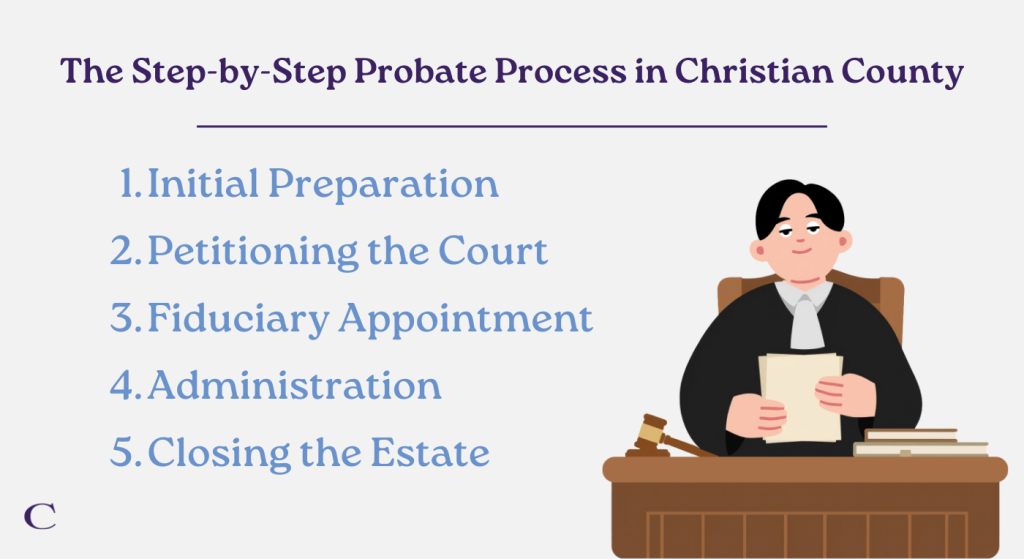
The Step-by-Step Probate Process in Christian County
There is usually a five step process that probate estates generally tend to follow. They include initial preparation, petitioning the court for appointment, fiduciary appointment, the administration of the estate, and finally, settling of the estate. Listed below is a brief explanation of each step.
- Initial preparation: This step primarily concerns gathering your loved one’s documents to provide to the court. These documents typically include the Will, a certified copy of the death certificate, a list of the assets and debts of your loved one, and a list of all heirs or beneficiaries with names and addresses.
- Petitioning the Court: This step involves filling out all of the critical information regarding your loved one who has passed. The petition is the form that takes all of the information gathered in the initial preparation stage and summarizes it for the court. The original Will, death certificate, and heir information should all be included on the petition or filed alongside the petition. Once properly documented, it is crucial to file with the District Court for fiduciary appointment.
- Fiduciary Appointment: Probate court is held on Monday mornings starting at 8:30 a.m., usually in Courtroom 2. Both District Judges hold hearings before appointing a fiduciary. Judge Cotthoff and Judge Adams alternate each week as the presiding judge. While both are effective and efficient from the bench, it is crucial that all of the information provided in the petition is correct and that proper notice has been given to the heirs or beneficiaries. If the petition has been properly filed, then the presiding judge will require you to sign a bond form and will swear in the fiduciary as either the Executor or Administrator of the estate. Once you have been appointed by the Court, the Clerk will issue a certified order of fiduciary appointment, granting you authority to act as the fiduciary of the estate. In Christian County, the Clerk typically has these orders ready the next day. For fiduciaries who reside out of town, they can ask the judge to pick the order up later in the afternoon on the same day.
- Administration: This is the longest and most important part of the process. At a minimum, Kentucky probate estates are required to be “open” for 6 months. This is due to the statutorily prescribed creditor period, a time in which creditors can come forward and file valid claims against the estate. As fiduciary, it is required by law for you to notify any known creditor of the decedent that they have passed and that a probate estate has been opened with the court. Additionally, it is crucial for the fiduciary to open an estate bank account in order to protect both themselves and the estate as a whole while dealing with assets, creditors, and heirs. This allows a centralized place for assets, in which the only one with access is the court-appointed and bonded fiduciary. In the meantime, the court allows a fiduciary 60 days to identify all assets of the decedent and file an inventory of the estate.
- Closing the Estate: After the creditor period has expired, then all valid creditor claims must be dealt with. Fiduciaries may file a disallowance of claim when a claim arises to try and bar the claim, or pay the claim once the time elapses. Once all creditors are either barred or satisfied, then the fiduciary can wind up the affairs of the estate and file a formal settlement, which requires an accounting of the estate from the time the fiduciary was appointed by the judge. The court also recognizes a more streamlined settlement process by allowing all beneficiaries or heirs to sign a waiver acknowledging receipt of their portion of the estate, along with a waiver of a more formal accounting. Once the settlement has been finalized, whether formal or informal, the fiduciary will close out the estate account and file the proper documents with the probate court. If the estate has been properly handled, then the judge will sign off on the order settling the estate, releasing you from your role as the fiduciary of the estate. In Christian County, when settlements are filed, neither Judge Cotthoff nor Judge Adams require the fiduciary to be present at the final settlement and allow the attorney representing the estate to appear on their behalf.
What Families Commonly Misunderstand About Probate in Christian County
While the five-step process may seem streamlined, there are several factors that can slow down or complicate the process. In reality, most probate estates can remain active for nine to eighteen months, depending on the complexity of the estate. Family disputes are usually the primary factor causing an estate to remain open for an extended period.
Additionally, a non-self-proving will, real estate title issues, and numerous creditor filings can delay settlement of the estate. Families often underestimate the amount of time required to administer a probate estate. The fiduciary’s role in winding up the affairs of the estate requires several hours of work, much of which is administrative and laborious for most individuals. Although the courts are generally “hands-off” in their approach to estate administration, they strongly emphasize the importance of employing an attorney should issues arise, as fiduciaries can be held personally liable for improper handling of the estate, even when errors are unintentional.
How Estate Planning Can Streamline the Probate Process
Proper estate planning can often avoid or substantially simplify probate by changing how assets are owned and how they pass at death. Assets held in a revocable living trust, owned jointly with rights of survivorship, or transferred by valid beneficiary designation—such as life insurance or retirement accounts—generally pass outside of probate and do not require court involvement to transfer. Even when probate cannot be fully avoided, thoughtful planning—such as a well-drafted will, clear fiduciary appointments, and coordinated asset titling—can reduce delays, lower costs, and minimize court supervision by making the process more predictable and less contentious.
Probate is unavoidable in certain circumstances, regardless of planning. If a person dies owning assets solely in their individual name without beneficiary designations or trust ownership, probate is required to legally transfer title. Probate is also typically necessary to clear title to real estate, resolve creditor claims, address tax obligations, or appoint a personal representative when there is no surviving joint owner or named successor. In addition, disputes among heirs, questions about capacity or undue influence, or defects in planning documents can require court involvement even when estate planning was attempted.
Probate Attorneys in Christian County
For individuals considering hiring a Hopkinsville probate attorney, practical preparation can make the process smoother and more efficient. It is helpful to gather key documents early, including the original will or trust, a death certificate, a list of known assets and debts, and contact information for heirs and beneficiaries. Understanding whether the estate is likely to require probate—and, if so, whether it is likely to be simple or contested—allows counsel to provide realistic timelines and expectations. A clear conversation at the outset about family dynamics, creditor issues, real estate, and prior planning helps ensure that the legal approach aligns with both statutory requirements and the practical realities of the estate.
To schedule a free initial probate consultation, contact Crow Estate Planning and Probate today. Our Hopkinsville team is ready to answer your questions and support your family throughout the probate process.
About the Author
Jonathon Garnett is an attorney at Crow Estate Planning and Probate, PLC. After serving as the firm’s summer clerk during his collegiate career, he joined our team of attorneys to lead our Hopkinsville office, assisting clients in the areas of estate planning, probate, conservatorships, and guardianships. He graduated with a Bachelor of Science in Economics from Western Kentucky University, then later earned his Juris Doctorate from the J. David Rosenberg College of Law at the University of Kentucky. Born and raised in Hopkinsville, he’s proud to serve the community his family has called home for many generations. Learn More.
Licensed in Kentucky